My name is Vedah, I’m 20 years old and I come from the Ključ area in Bosnia. I grew up between town life and visits to the countryside, but like many people my age I dream of moving to Sarajevo. For a long time that dream was quite vague: I knew I wanted something creative, something connected to people and to nature, but I had no idea what form it could take.
I definitely never imagined myself as “someone who starts a business”. That phrase sounded like it belonged to other people – people with money, contacts, or some kind of special talent. I liked drawing, music, cooking for friends, and talking for hours about ideas, but I didn’t see how any of that could become real work.
That started to change when I joined FoodBack.
When I first heard about FoodBack, I thought it was “just” a project about food and sustainability. I was interested because I care about the environment and I like cooking, but I didn’t expect it to change the way I see my future.
We began with a local workshop in my town. There we explored topics like food systems, waste, local products, and how food is  linked to climate change and the environment. We also had our first introduction to the idea of creating small business concepts. At that time I tried to design a small initiative for my village – something modest, more like a side activity than a real company.
I remember sitting with my notes, drawing arrows and writing words, but feeling unconvinced. The idea didn’t excite me. It felt like I was forcing myself into a box that didn’t quite fit. I still didn’t see myself as an entrepreneur; I was just playing with the format because that was the task.
Everything started to shift during the youth seminar in Italy.
In Italy I met participants from different countries, including two people from Montenegro who would become very important for my journey. The days were full: workshops on food and climate, cooking sessions, discussions about circular economy, entrepreneurship and group work. I started to see the bigger picture: food was not just something on a plate, it was connected to land, water, energy, culture, identity, and the way we organise our societies.
We did a lot of group work, games, role plays, and real-life case studies. We were analysing food waste in restaurants, then designing imaginary “green” businesses and then testing them in front of others..
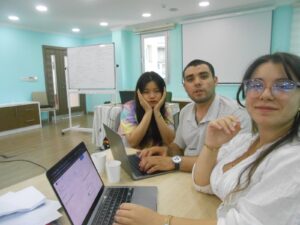
It was during one of these group exercises that the idea of Nature’s Palette was born. I was put into a team with the two Montenegrin participants. We realised that all three of us were passionate about art, food and the environment, and that we loved the idea of creating spaces where people could experience all three together.
From those sessions came the vision: an art gallery, workshop space, and restaurant, designed for families and young people who care about the environment and seek meaningful experiences rather than just another place to eat.
By the end of the seminar we had turned that vision into a real business plan: target groups, mission and values, a simple financial projection, a marketing strategy, and even a concept for social media. For someone who had never considered starting a business, it was a strange feeling to look at those pages and think, “This could actually exist.”
What changed most for me in Italy was my confidence. I realised that entrepreneurship is not magic; it is a process you can learn.
Still, even after the seminar, parts of the idea felt a bit abstract. We talked a lot about “local food” and “sustainability”, but I knew I was missing a deeper understanding of where those ingredients would come from and how they connect to real farmers’ lives. I was lucky to have a job-shadowing opportunity.
 I ended up at the Hasanbegović Family Farm in Kamičak, a village along the Sana River. The funny thing is that it is not far from where I live in Ključ, but before FoodBack I had never heard of it. It made me realise how many interesting things are happening around us without our knowledge, simply because we are not looking.
When I arrived, it was mid-February. The landscape looked quiet – bare trees, cold air, damp earth – but there was a feeling that everything was getting ready to wake up. The farm is big: about 30 hectares. It is run by Hajrudin and his son , Elvedin, both of whom also have full-time jobs. They get up early, finish late, and also fit farming into their day. Seeing their routine up close gave me a new respect for the phrase “locally produced”. It’s hard work.
In good Bosnian style, they treated me as part of the team. Mornings started with the animals – sheep and chickens – and then I moved on to whatever needed doing in the fields or greenhouses.
Most of the work during my month there was about preparing for spring and summer. We turned the soil, removed stones, spread manure and compost, and shaped the beds for potatoes, onions, peppers, tomatoes and cucumbers. I had been throwing around words like “seasonality” and “crop planning” in my business plan, but they became very real.
In the greenhouses, trays of seedlings waited on benches, tiny, fragile plants that would eventually become crates of vegetables. I finally understood the scale behind one simple menu item. If I wanted to offer “simple tomato salad” every day in summer, someone had to do all of this months in advance. Respect.
I discovered a world of aromatic and medicinal plants that would end up shaping a whole part of Nature’s Palette. The farm and the surrounding area are full of herbs – some cultivated, some gathered wild: mints, chamomile, sage, thyme, hops, linden and others. People there use them to make herbal teas and home remedies, just like my own family and many other families in the region.
I grew up with this – jars of dried herbs in my grandmother’s kitchen, steaming cups of tea for every possible situation – but I had never thought of it as anything special.
I began to imagine a tea corner in Nature’s Palette, where guests in Sarajevo could choose blends connected to real landscapes: a Sana River mix, a Ključ hillside infusion, a “Grandma’s visit” blend inspired by those holiday trips to the village when you come back with bags full of jars and bottles. It felt like a way to bring the countryside into the city in a humble but powerful form.
This idea connected strongly with my reflections during FoodBack about how many people in cities still rely on rural relatives for “real” food – potatoes, beans, cured meats, jams, juices. I want my future place to recreate that feeling: of arriving somewhere and being welcomed with products that could easily have come from your grandmother’s pantry.
I travelled with Hajrudin or Elvedin to deliver vegetables to shops and markets. We loaded crates into the van and then unloaded them at supermarkets and small shops. I saw a side of the food system I had never really thought about. The relationships were friendly but also tense at times, with time always being a limit. I now understand what working with local suppliers can mean. Thanks to FoodBack, I already knew in theory about supply chains and the problems of industrial food systems, but here those ideas wore work gloves and drove a van.
I really enjoyed working on the small barbecue and picnic area by the river and the guest house they are slowly building to bring the community together: places where people can come, relax, and eat food that has travelled only a few metres.
Watching how Hajrudin and Elvedin think gave me a live lesson in entrepreneurship. They are constantly looking for opportunities that fit their land and their skills: new crops, improving facilities, thinking about tourism activities, making sure they don’t rely on just one source of income, while trying to keep their village alive.
By the end of my month on the farm, the different parts of my FoodBack journey started to come together.
Nature’s Palette changed shape because of all this. The idea of combining art, workshops and a restaurant stayed, but the content became more precise and more authentic. I now see the restaurant not just as a place to eat but as a bridge between Sarajevo and places like Ključ and Kamičak. I want to serve dishes and drinks based on lesser-known local crops, traditional grains, seasonal vegetables and herbal teas that carry stories from the countryside. I want guests to feel, for a moment, as if they have stepped into that world of summer visits to grandparents, even if they never actually had that experience themselves.
Even though my goal is to move to Sarajevo, I feel more connected than ever to the region I come from and I want to bring these roots with me.